
.png)
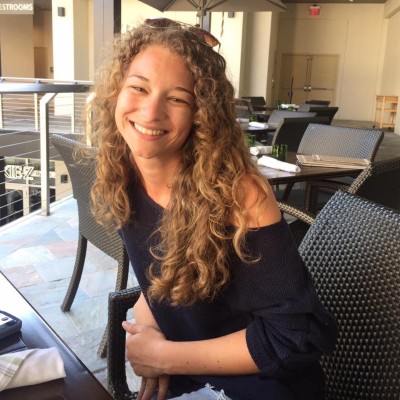
From a young age, Kendall Bedford was taught to love and appreciate the natural world, and it shows. If she had it her way, her home would look like an animal sanctuary.
“I keep telling my partner, if he doesn't control me, one day we will have a zoo in our house,” she half jokes. “I think animals are so fun and neat.”
Kendall lives in the suburbs of Philadelphia with her partner and two cats, Neville and Loki. She has also been dreaming up names for a future puppy, which will likely be based on a sci-fi TV show character.
Her early passion for animals once shaped her vision for the future — a path that ultimately led her away from conservation and into the warp-speed world of technology and finance.
Today, Kendall is a senior associate at SustainVC, an early-stage, multi-thematic impact fund investing in everything from climate tech to fintech startups with measurable social or environmental missions.
Her work toward positive change does not stop at her job. She is also co-chair of the talent and diversity working group for Impact Capital Managers, which creates reports focused on inclusion and underrepresented talent in impact venture capital. In 2025, she was acknowledged as the organization’s emerging leader.
Kendall’s pride in uplifting all communities — including animals — connects back to her Quaker upbringing. To say the least, she is not the average venture capitalist.
Rooted in Faith and the Outdoors
Both of Kendall’s parents were Philadelphia natives who chose to raise their two daughters in the same type of neighborhood she lives in now. She was raised with Quaker principles, something she believes continues to guide her values.
Attending Quaker schools was largely a family expectation. Like her mother and sister, Kendall attended a local Quaker high school.
“I was just like, yep, I'll go to that school as well.”
She says one of the most important aspects of her childhood was the amount of time she spent outdoors.
“I think that my generation was maybe one of the last ones to be told to go outside and be home by sunset without any sort of parental monitoring,” she reminisces. “So I spent a lot of time playing in the woods with my friends.”
That connection to nature was reinforced at home. Kendall’s father, a devoted outdoorsman, was adamant about teaching his children how to be one with the natural world.
“He wanted his daughters to both have the same sort of comfort being outside, being in the wilderness, and loving the planet that we have,” she explains. “I think that that really resonated with the Quaker education as well.”
From Ecology to Impact Investing
The Quaker testimonials taught Kendall to protect the world around her and to serve her community — values that followed her into adulthood.
“I think that as I got older, that kind of teaching of, respect those around you and respect the earth around you, really influenced how I saw the world,” she says.
By the time Kendall left for college, she was focused on her career goals. Her love of animals and conservation led her to study ecology, culminating in a senior thesis in Kenya analyzing giraffes’ social structure and the impact of human activity on degraded land.
“I'm not the kind of person that can do a job that doesn't mean something to me,” she asserts. “I have to do something that ties to my personal values. I can't do a job where I don't go to sleep feeling proud of what I've accomplished.”
Despite her dedication to the natural world, her time in Kenya shifted her perspective.
“I spent some time both in the conservation areas, but also on the group ranches where the people lived,” she recalls. “I realized that it's really hard for people to think about saving the giraffes when they're thinking about their next meal.”
The experience forced Kendall to rethink her future and ultimately shook her commitment to a traditional conservation path, including plans for veterinary school. “I realized that being in academia wasn't necessarily for me.”
After college, Kendall pivoted to the private sector, which placed her on a path toward sustainability consulting. She was later introduced to impact investing — a field she initially knew little about.
That changed when she discovered the Mosaic Fellowship, created by Impact Capital Managers to recruit underrepresented talent into the space. Intrigued, she applied and was accepted.
Though originally unsure, she quickly found a sense of belonging.
“It was really nice to be a part of a group of people who were here to make this work. We are here to do well and do good,” she says. “A community of people I wanted to interact with and have some variability in terms of outcomes and inputs for what I was doing.”
“It just really resonated with what I wanted to spend my time accomplishing.”
Finding Belonging in Venture Capital
As a Black woman in venture capital, Kendall understands how rare Sustain’s values can be in a cold, colorless industry. She credits her team for creating space to openly discuss difficult issues.
“I think that if I wasn't able to communicate these sorts of feelings it would be a very different situation.”
Still, those challenges often surface the moment she walks into a room.
“Either I'm the only woman or I'm the only woman of color,” Kendall explains. “Sometimes I'm also the only person of color, which is kind of a bummer.”
She says one of the hardest parts of her job is the loneliness that can come with that isolation. Those experiences have shaped the most important lesson she carries: Advocate for yourself.
“I'm not going to pretend that it is easy all the time and that there are spaces in which you don't want to advocate for yourself,” she admits. “But if you're quiet about it, nothing's going to change.”
Even with that wisdom, Kendall continues to hear stories of bigotry that make her skin crawl. Her approach to changing biased viewpoints is simple but effective.
“Investing in non-homogenous groups of people is just good investing.”
“It is a bad investment strategy to only invest in people in your network or who look exactly like you,” she explains, noting that her exclusively investing in Black women who went to Princeton would be equally flawed.
“So why are we excusing the behavior of other people, VCs that only invest in white male entrepreneurs?” she asks. “That's not the America that I want to be a part of — it's a melting pot.”
Staying Grounded in Uncertain Times
Kendall believes her Quaker background and life experiences reinforce the importance of being an active member of one’s community.
“I think that that is a part of my role. It's not just investing in the founders. It's not just investing in the tech, it's what can I do to make impact investing on the whole better? It takes a lot of time.”
Her work with Impact Capital Managers is one way she seeks to push change from within.
“I cannot change the industry on the whole, but I can help put out reports,” she says. “I can help have conversations with people.”
In a time of political uncertainty, Kendall has concerns about the lasting effects the Trump administration will have on impact investing. She believes it has already caused damage, particularly by creating fear in the space.
Investors now question whether there will still be a market for their services — a concern she consistently answers with a yes, citing real demand for their products and platforms.
“But that fear is going to result in a pullback,” Kendall explains. It has led her fund to reevaluate companies solely reliant on grant funding, particularly in climate research and development.
Still, she sees opportunity ahead. Over the next few years, Kendall believes there is room to double down on intersectional climate issues, like companies bridging the gap between insurance and climate risk.
“There is an opportunity to keep putting money to work, and I don't think we should be as afraid as the news cycle seems to rely on us being,” she assures.
Even in the face of political resistance, Kendall finds hope in the founders she works with.
“I get a lot of joy in my life just talking to founders,” she says. “I am not a hopeful person, I'm not a particularly cheerful or positive person – but I feel really good speaking to all those entrepreneurs and knowing that there are still so many investable opportunities for us."
“That is a really big positive considering people are so worried about the pullback and the shutdown. It’s uplifting to know that these entrepreneurs are going to keep going regardless.”
About Beta Boom
Beta Boom is pre-seed and seed fund investing in founders who defy the mainstream.

BETA BOOM BACKS ORIGINALS
Investing at the pre-seed and seed stages in founders who defy the mainstream.
.png)
.png)