
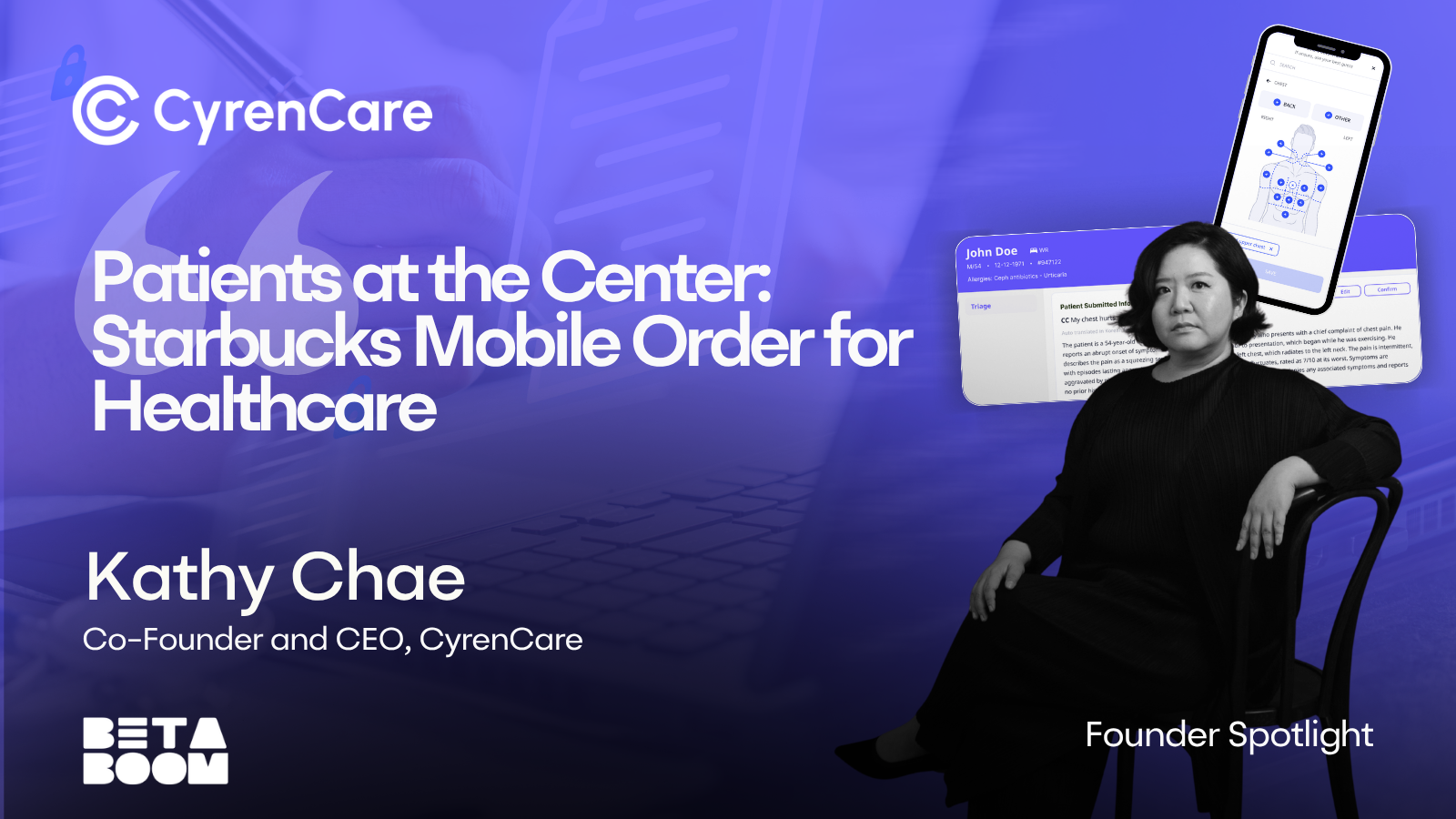
CyrenCare is a hospital communication and patient intake platform, integrated inside the EHR, founded by Emergency Medicine physician Kathy Chae. It runs hospital-wide inside Seoul National University Hospital and is a participant in the Center for Medicaid and Medicate Services (CMS) Kill the Clipboard initiative, which lets patients collect their own scattered medical history and hand it off to clinicians instead of filling out the same paperwork at every visit. Chae is being featured as an innovator at the PitchER Innovator Meetup at ACEP26 in Chicago this October.
Before any of that, Chae pitched CyrenCare to a group of early-stage healthtech investors, all men. Afterward, in the anonymous survey, 90 percent of them said she wasn't fit to lead the company she had built. What stuck with her wasn't the verdict. It was that most of the room hadn't been listening in the first place. “Some were driving during the pitch,” she says. “Many were obviously not paying attention, and their questions made it obvious they hadn't followed any of it.”
She didn't argue back in the room. “The only real answer is traction and action,” she says. Two years later, CyrenCare closed an enterprise deal with Seoul National University Hospital, one of the best hospitals in Korea. “If you underestimate people by what they seem, it's a loss on your side.”
Who Is Kathy Chae?
Chae is an Emergency Medicine physician and a former EM professor at Ajou University. She is also the founder and CEO of CyrenCare, a Beta Boom portfolio company. Before founding CyrenCare, she published post-cardiac arrest research and built a text-based physician communication system inside her own hospital's EHR, the system that became CyrenCare's starting point.
What was the Motivation to Start CyrenCare?
It started as a fix Chae built inside her own hospital's EHR, years before CyrenCare existed. Emergency Medicine physicians at her hospital were spending five hours a day on the phone, at least 100 consultation calls a day, and every time a specialist didn't pick up, that turned into two or three calls at three minutes each.
“The time wasn't the worst part,” she says. “It's 2 AM, you need a specialist on a critical patient, and you're trying to get through to someone in no mood to be interrupted. A hundred times a day.”
She led the move from calling to texting through the EMR. Two clicks, secure text, status visible to everyone. A surgeon in the OR could answer with two clicks, “In surgery, expect an hour delay,” and that update reached the ED team and the patient instead of leaving them waiting in the dark. If nobody responded in time, it escalated automatically to the next person in line. It took two years and a lot of pushback to get there.
“The moment I knew was when no one could go back,” Chae says. “The same people who fought it can't live without it now. Who wants to call, or get called, every couple of minutes?” That was the moment she realized the same fix could work for how patients and clinicians communicate. That's what motivated her to start CyrenCare.
Why Did Kathy Chae Leave Academic Medicine?
Before CyrenCare, Chae was publishing post-cardiac arrest research as an EM professor at Ajou University. Leaving wasn't about the research being unimportant. It was about speed. “Academia is slow, careful, peer reviewed, consensus driven,” she says. “It is the right speed for research and the wrong speed for fixing a workflow problem that hurts people on every shift.”
Chae realized that she could not both be a researcher and solve this problem quickly. “There was no version where I kept a tenure track position, worked all the shifts, kept publishing, and did this on the side,” she says. “I would have done both badly. So I chose. I left to give this the whole thing, because the possibility only exists if somebody puts everything into it.”
How Does CyrenCare Work Across an Entire Hospital?
CyrenCare solved its hardest problem first, inside emergency medicine. But hospitals don't buy point solutions. “It didn't matter that we had solved the hardest workflow in the building,” Chae says. “The ED alone was not a purchase anyone wanted to make.” So CyrenCare went hospital-wide so the ED could have access to it at all.
Three things changed to make that possible. The first is no-code EHR integration, the piece Chae is proudest of: users can map data into any field or form in their own EMR themselves, without waiting on engineers. The second is deployment. Seoul National University runs its own environment, so CyrenCare builds, releases, and operates inside the hospital instead of from the cloud. “Our client's security requirements are set at the national intelligence level, closer to what you'd expect around a defense system than a hospital, because North Korea is right there,” Chae says. “That changes everything about how you ship and how you debug. We accepted the challenge for our users.” The third is operational: weekly meetings with the hospital's main operators, and monthly meetings with a taskforce of representatives from every specialty and service line.
What Did CyrenCare's Pilot Study Find?
A pilot study at Samsung Medical Center set out to test one hypothesis: that having patients organize their symptoms in advance would help clinicians. What the team didn't know was whether patients would find the process annoying.
Instead, one word kept coming back. “The word that stayed with us was reassured,” Chae says. “Not faster. Not more efficient. Reassured.” Patients felt reassured putting their story in order and knowing it wouldn't get lost. That reframed what the product actually was. The team kept the patient-facing questions in plain, everyday language instead of clinical language, and handled the translation into clinical terminology on their own side. “They are writing their own clinical narrative,” Chae says. “Once we understood that, we were reassured too, that this is something patients want as much as clinicians do.”
What Is Kill the Clipboard?
At ACEP26 this October, Chae wants to talk about Kill the Clipboard, CyrenCare's part in a CMS initiative that every Emergency Medicine physician recognizes by feel. “A patient arrives and we ask what medications they take, what surgeries they've had, what they're allergic to,” she says. “They don't remember, or they can't tell us. Their records sit in three other hospitals we can't see. So we start from nothing on someone who is sick.”
CyrenCare lets patients pull their own scattered medical history together, capture their present illness in their own words and their own language while they wait, and hand that off into the EMR through an interoperable QR code, no clipboard required.
The technology, Chae says, isn't actually the hard part. “This is work that has to be led by the government,” she says. “There are too many stakeholders for one company to solve, everyone has to move together, and it's an ongoing project.” What has to happen first is a shift in thinking: a shared agreement that the patient owns their data. “Until that agreement exists, every data gatekeeper keeps their guard up,” she says. “Once the guard comes down, the work changes. Then it is curation, organizing all of that scattered data and delivering it in a form the user can actually use in the moment.”
What's Next for CyrenCare Beyond the ED?
Chae sees CyrenCare's next market in a place most people wouldn't connect to an ED workflow tool: clinical trial recruitment. “Drug discovery keeps getting faster,” she says. “Finding patients to participate has not gotten faster at all. That gap is the real bottleneck in the industry, and it is a matching problem dressed up as a recruitment problem.”
Today, a site starts with a protocol and goes hunting through charts for patients who might fit, and a patient usually never even learns the trial existed. CyrenCare flips that. About 70 percent of the data CyrenCare already collects overlaps with what a trial protocol screens for, which means most of the matching work is done before anyone goes looking. Because it's already collecting structured clinical data from patients, in their own words, the moment they walk in, patients could find trials that fit them instead of trials hunting for patients, without language or geography getting in the way.
What Happened When CyrenCare Went Live at Seoul National University Hospital?
Asked what she wants to share about CyrenCare this month, Chae doesn't point to a metric. She points to a morning. When CyrenCare went live at Seoul National University Hospital, she went out to the clinics herself. She was in the gastrointestinal surgery outpatient office at 8:30 AM. The clinic didn't open until 9, and the waiting room was already packed with cancer patients.
A handful of nurses were working through paper forms, collecting information by hand and retyping all of it into the EMR. “That is the entire problem, sitting right in front of you before the day has even started,” she says.
“When we walked in, they were happy to see us. Genuinely happy.” Chae says. “They told us this was actually helping their work. I have spent years in rooms explaining why this matters. That morning, nobody needed the explanation.”
She Let the Users Decide.
A group of male investors once decided, without listening, that Chae wasn't fit to lead the company she'd already built. She didn't argue. She went back to the hospital, and let the work and her users speak for her. Two years later, CyrenCare went live across every clinical department at the best hospital in Korea. On launch morning Chae stood in a packed gastrointestinal surgery clinic before it had even opened, watching nurses who were genuinely glad to see her. "After all the meetings and the security reviews and the change management, that is the part I will remember," she says. "It's an idea that works in your head until the morning you watch it take work off someone's hands and make their lives better."
FAQ
What does CyrenCare do?
CyrenCare is a hospital communication and patient intake platform, built inside the EHR, that lets patients organize and hand off their own medical history instead of repeating it on paper forms. It runs hospital-wide at Seoul National University Hospital, across all specialties and service lines beyond the emergency department where it started.
What is Kill the Clipboard?
Kill the Clipboard is a CMS initiative CyrenCare has pledged to, aimed at letting patients collect their own scattered medical history from wherever it lives and bring it with them. CyrenCare captures a patient's present illness in their own language while they wait and pushes that information into the hospital's EMR through an interoperable QR code.
Why did Kathy Chae leave academic medicine to start CyrenCare?
Chae was an EM professor at Ajou University publishing post-cardiac arrest research when she concluded that academia moves too slowly to fix a workflow problem hurting patients on every shift. She decided she couldn't do a tenure-track position, clinical shifts, and a company all at once without doing all three badly, so she left to build CyrenCare full time.
Where is CyrenCare headed next?
Chae says CyrenCare's next market beyond the emergency department is clinical trial recruitment. Because the platform already collects structured clinical data from patients in their own words as they walk in, she sees an opportunity to match patients to trials they qualify for instead of sites hunting through charts to find participants.
About Beta Boom
Beta Boom is pre-seed and seed fund investing in founders who defy the mainstream.

BETA BOOM BACKS ORIGINALS
Investing at the pre-seed and seed stages in founders who defy the mainstream.

.png)
.png)
.png)