
.png)
Right before Dr. Anne Germain told anyone at the University of Pittsburgh she was leaving, she got a tattoo. Carpe Noctem, seize the night, across her arm, the same phrase she's since used to describe why she left academia to build NOCTEM. She hadn't told her department chair yet. She hadn't told most of her friends. She made the commitment clear to herself first, before saying it out loud to others.
Dr. Germain spent 25 years training the small number of specialists in the world qualified to deliver CBTI, the most effective treatment for chronic insomnia. Fewer than 500 people worldwide are trained to deliver it. She watched almost every one of them hit the same wall. So she left her tenured position to go build something else.
Dr. Germain is now the founder and CEO of NOCTEM Health, a Pittsburgh-based company built around COAST, a platform that keeps a clinician in the loop instead of trying to automate them out of the picture. Before NOCTEM, her research at Pitt focused on insomnia, nightmares, and trauma-related sleep disorders, largely in military and veteran populations. Founded in 2019 and still a lean team, NOCTEM already counts Stanford Health Care, Intermountain, and Penn State Health among the health systems it works with. Eighty-two percent of patients who start a COAST program complete it, and 52 percent reach full remission. Beta Boom led NOCTEM Health's seed round last year.
"Deeply Heartbreaking"
Every time Dr. Germain sent a newly trained specialist out into the field, she believed the same thing.
"This person is going to change the lives of so many people," she said. Then she'd watch it not happen. Not because the clinicians weren't good. They ran into clinics with no room for them, mandates stacked on mandates, leadership that treated sleep as an afterthought, and schedules that were never built for the kind of care CBTI actually requires.
"Deeply heartbreaking," is how she describes it now. It took her years to stop blaming systemic barriers. She eventually decided the therapy, the science, and the training were perfectly fine and effective. What failed was implementation. The status quo kept sending well-prepared people into systems with the wrong tools to practice what they knew.
Not The Same Thing As Treatment
"While the rest of her field debated the problem at conferences, Dr. Germain went and used the sleep trackers and wellness apps herself and with patients."
What she found was that most of the industry had built customer products that the general public, including sleep patients, mistake for clinical diagnostic or treatment tools. The apps look good, and the sleep score gives people a small hit every morning, and none of that is inherently bad. It's just not a diagnosis or a treatment. Unfortunately, most patients can't tell the difference. People would fixate on pushing their score higher, as if the number itself were the cure. There's a clinical term for when that backfires: orthosomnia, a kind of insomnia caused by anxiety over your own sleep tracker. Dr. Germain's way of putting it: seeing a dashboard warning light doesn't make you a car mechanic.
The apps built on real clinical content had a different problem. Without a clinician watching, nobody could tell what was actually happening. A patient would say it didn't work, and there was no way to know what that meant. Did they follow the program for two days or two months? Did they follow it at all?
By the end of it, she'd decided the industry had been missing a key part of the solution to this problem. Nobody was short on data. People were short on care they could actually get to, delivered in a form that fits how healthcare really runs.
It Found Her
Dr. Germain didn't wake up one day and decide to start a company. It found her.
The real turning point was a proof of concept with military patients dealing with severe insomnia layered on top of PTSD and traumatic brain injury. Instead of stripping the clinician out of the process, the direction the rest of digital health was racing toward, she kept them in it. Engagement outpaced what tech-only tools were seeing elsewhere, and outcomes held up against traditional in-person therapy.
Not long after she published those early results, two hospital systems and three private companies reached out on their own, wanting to build a commercial version with her. That was the moment it became clear there was a business underneath the research question. Around the same time, two mentors she trusted asked her, directly, what she wanted her academic legacy to actually be. She said it kept her up at night. Eventually she decided to find out whether the science she'd spent decades writing grants about would hold up outside the lab.
The people closest to her weren't shocked when she told them. Most said go for it. A few worried out loud about the risk, which she says actually helped, because it forced her to clearly explain to herself why she was so sure. By the time she'd made her case to them, she says they were fully behind her.
Memento Mori
Dr. Germain doesn't describe this as a regret-free decision. There have been moments, she admits, where she's wondered if life would be simpler if she'd stayed at Pitt.
For those moments, she has a second tattoo: Memento Mori. She's quick to say it isn't as dark as it sounds. It's more like something that snaps her back to what actually matters, and reminds her how fortunate she is to be surrounded by people who believe in the vision, and by providers who trust what NOCTEM Health's solutions can do to help them treat their patients.
Building The Ship While Underway
Long before well-known systems such as Stanford Health Care or Intermountain adopted the platform, Naval Medical Center San Diego was one of the first to take a chance on the early, unproven prototype. It wasn't a cold pitch. It grew out of a decade of collaboration with their clinical and research teams, including Retired USN Captain Justin Campbell, Dr. Rachel Markwald, Dr. Emmanuel Espejo, and Dr. Lars Hungerford, along with other champions at NMCSD who took the idea seriously before it had proven anything.
The patients they treated together carried severe sleep disturbances tangled up with PTSD, TBI, and chronic pain. Dr. Germain describes that stage of building the company as building the plane while flying it, or, as she also put it, building the ship while it was already underway. What it proved wasn't just that the technology worked. It proved that a clinician and technology together could hold up in a real clinical setting, under real pressure, with patients who couldn't afford for it to fail. Watching two decades of academic work turn into something operating in the field, she said, felt truly incredible.
Sleep As The Foundation
A colleague recently sent Dr. Germain an image, two versions of the same building. In one, sleep is just another column holding up the roof, next to nutrition, exercise, and mental health, one pillar among several. In the other, sleep isn't a pillar at all. It's the foundation the whole building sits on.
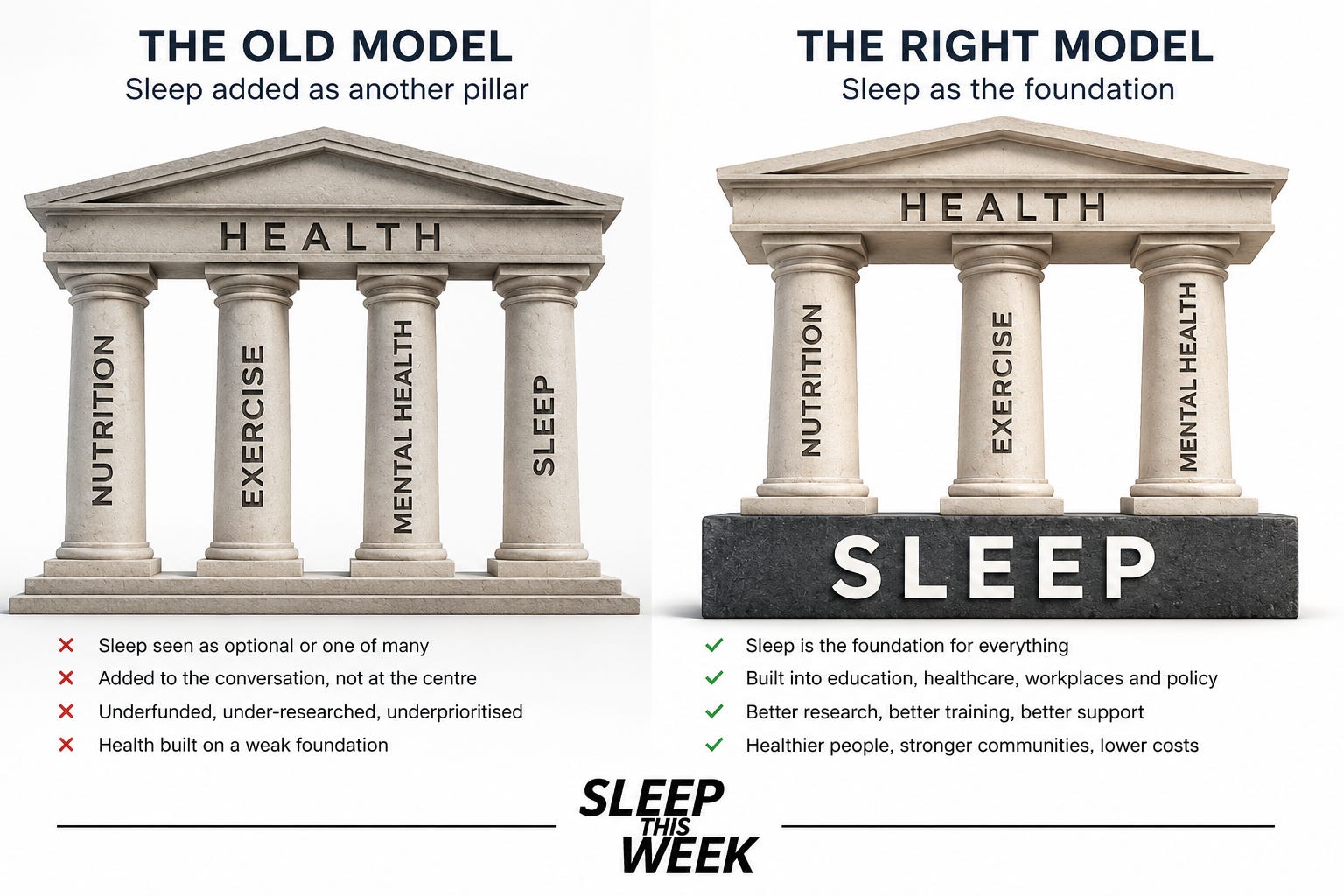
That's more or less her theory for why behavioral sleep medicine never became a routine part of healthcare the way it probably should have. Most providers still treat sleep as a kind of default setting, something that only matters once it's flagged as secondary to whatever else is going on with a patient. Dr. Germain thinks that's backwards. Sleep isn't one item on a checklist next to everything else. It's what the rest of a person's health stands on.
That same instinct shapes how she talks about AI. She's skeptical of anyone pitching AI as a replacement for clinicians. What interests her is AI reducing the friction between practice guidelines, the data that gets collected, the clinical decisions that get made, and the patient in front of a clinician who needs care that's actually personalized to them, not a generic protocol.
"Adopt COAST"
Asked what she'd say to a clinician standing exactly where she stood ten years ago, running into the same wall that used to stop her own trainees, Dr. Germain didn't take long to answer.
"Adopt COAST, and multiply the good you can do with the next generation of digital sleep care."
It's a strange thing to say out loud, but it makes sense coming from someone who spent 25 years training specialists one at a time before deciding that was never going to be enough.
Seize The Night
There's a version of this story where Dr. Germain stays at Pitt. She keeps writing grants and articles, training specialists, one at a time, for as long as her career allows. It's a good life. Nobody would have blamed her for it.
She has a tattoo instead. Two of them, actually, for the two halves of what it took to leave. One told her to go. The other reminds her why she still hasn't looked back.
Most founders will tell you the moment they knew. Dr. Germain will tell you it took 25 years, a wall she kept hitting on other people's behalf, and a decision she made permanent on her own skin before she said it out loud.
She's the one who left. If you believe you have a solution to a problem that keeps repeating itself, what are you waiting for?
Frequently Asked Questions
What is CBTI (cognitive behavioral therapy for insomnia)?
CBTI is the treatment most sleep doctors consider the first choice for chronic insomnia, ahead of medication for most patients long-term. The issue has never been whether it works. It's that there aren't nearly enough trained clinicians to deliver it.
Who is Dr. Anne Germain?
Anne Germain, PhD, is a sleep researcher and clinical psychologist who spent 25 years on faculty at the University of Pittsburgh, focused on insomnia, nightmares, and trauma-related sleep disorders, largely in military and veteran populations, before founding NOCTEM Health in 2019.
What does NOCTEM Health's COAST platform do?
COAST is a remote monitoring platform built to support a clinician delivering CBTI, not replace them. It handles data collection and scoring so the clinician can spend more time on the clinical decisions that require judgment, instead of everything else.
What does "clinician-in-the-loop" mean in digital therapeutics?
It means the technology supports a clinician who stays actively involved in a patient's care, instead of trying to automate the clinician out of the process. NOCTEM's early research found this produced better patient engagement and outcomes than fully automated, tech-only approaches.
What is orthosomnia?
Orthosomnia is a form of insomnia or sleep-related anxiety that can develop when someone becomes overly focused on optimizing their sleep tracker's score, a number with little established connection to actual sleep quality.
About Beta Boom
Beta Boom is a pre-seed fund investing in startups solving complex workflows in enterprise, cybersecurity, and health.

BETA BOOM BACKS PATTERN BREAKERS
Investing at the pre-seed and seed stages in founders who defy the mainstream.

.png)