Ask Advait Raykar where the name Elm AI came from, and he will simply state,
“I wish I had a great story for [the name], but honestly, there isn't one. Elm AI was a name we liked, and it stuck.”
While the name was serendipitous, the company was born out of a very intentional vision and plan.
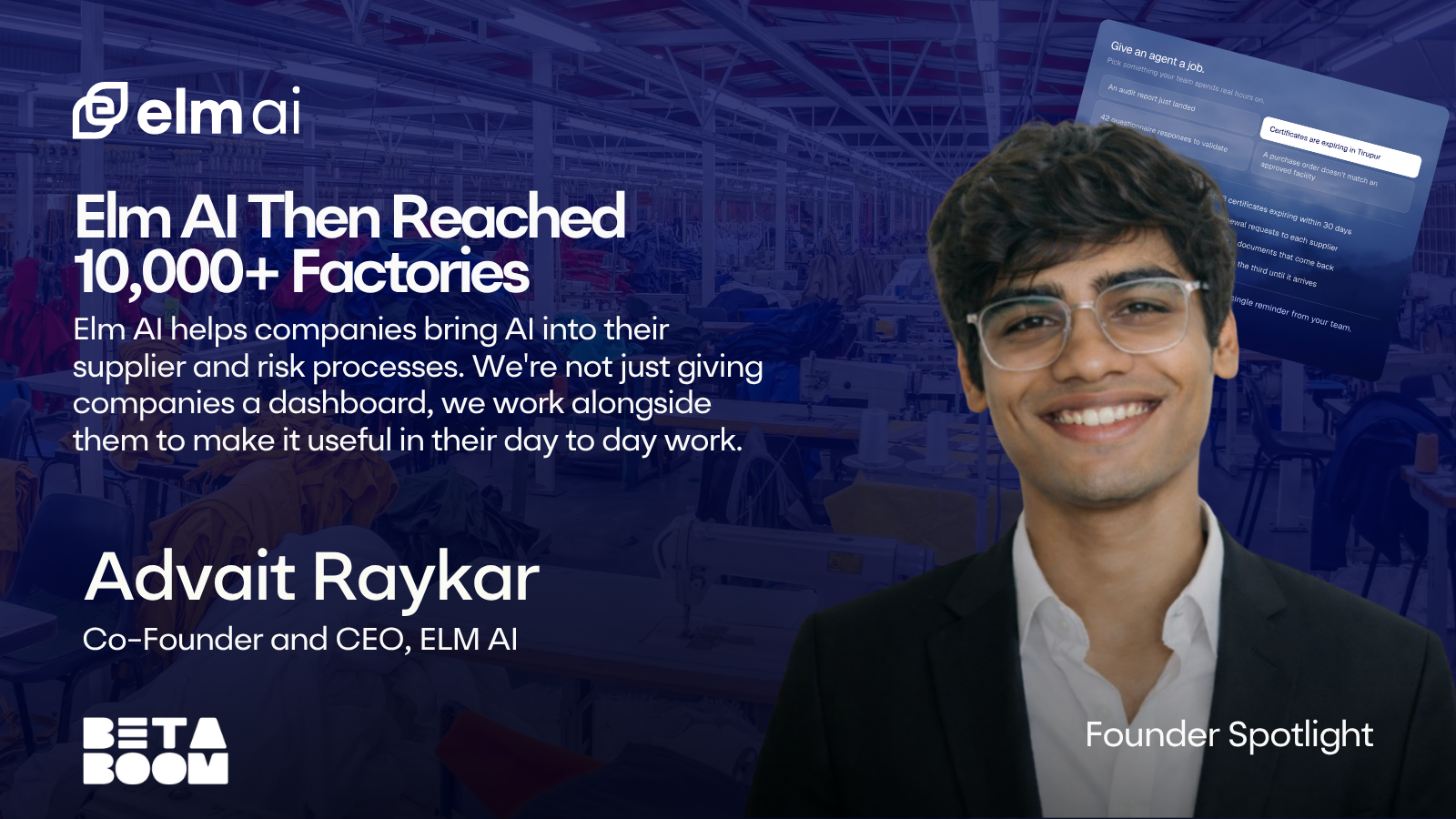
Elm AI builds AI agents for procurement, sourcing, compliance and operations teams at global brands and retailers. Its systems support supplier programs spanning more than 10,000 factories in over 50 countries, helping teams review audits, track certificates and documents, validate supplier questionnaires, follow up on corrective actions and screen purchase orders.
Advait started the company because he believed supply chains were a better place to apply AI than other more obvious spaces. While the work might be less visible than a consumer product or a developer tool, it affects how physical goods brands like Everlane and Stitch Fix buy, make and move products—and how much waste and risk sits inside those processes.
The name grew into the mission
The meaning of the Elm AI name came later, through the work the company took on.
“Now, when I hear Elm AI, I think about using AI to make global supply chains work better and helping companies make products in a more sustainable and ethical way,” Advait says. “That matters much more to me than creating a clever story about the name.”
That view now shapes the company’s approach: start with the way a team actually operates, then put AI into the parts of the process where it can reduce manual work and help people make decisions sooner.
Why supply chains
Before founding Elm AI, Advait worked closely with the founders of Vernacular.ai as the company scaled. He saw from the inside how quickly AI was improving and how much software teams could build around it.
That experience also made him think about where he wanted to spend the next decade.
“If AI was going to change so much, I wanted to work on something where the upside was bigger than just building better software,” he says.
Supply chains became that focus.
“Supply chains touch almost everyone in the world,” Advait says. “If we do this right, companies can run better, waste less, and make things in a more sustainable and ethical way. That felt worth starting from zero for.”
The company is a Cornell spinout, but its work quickly moved beyond the university. Elm AI now works with teams responsible for supplier relationships and day-to-day operating decisions across large, complex businesses. It is headquartered in New York and has opened a European headquarters in London to support customers across the region.
Making AI useful inside existing work
Advait is careful not to describe Elm AI as another dashboard or a generic supplier-risk product. Supplier risk is one part of the company’s work, but the broader goal is to help teams apply AI across supplier operations, relationships and compliance processes.
“We look at how teams actually work, where information is fragmented, where people spend time pulling things together manually, and where important decisions get slowed down,” Advait says.
The company then configures AI agents around each customer’s operating context and a specific problem. That can mean reviewing audit materials, checking certificates, validating questionnaire responses, monitoring corrective actions or screening purchase orders. The point is not to add another system for people to monitor. It is to help them focus on the suppliers that need attention and act sooner.
“We are not just giving companies another dataset or dashboard,” Advait says. “We work alongside them to make AI useful in their day-to-day work and help them get real outcomes from it.”
That deployment model matters because supplier data is rarely clean or uniform. Information may be spread across documents, email, spreadsheets and existing systems, with different teams responsible for different parts of the process. A useful product has to work with those conditions rather than assume they do not exist.
The first proof came from real customers
Trust was the early challenge. Many companies were interested in AI before they were ready to rely on it in operational work.
“People liked the idea, but they were not always sure it would work in the real world,” Advait says.
Elm AI had to show that its systems could handle real supplier data, fit into established workflows and produce something useful beyond a polished demo.
Reformation was one of the early customers willing to try. The sustainability-focused clothing brand gave Elm AI an opportunity to work inside a real supply-chain environment at a time when many companies were still deciding what AI could reliably do.
“Reformation saying yes was a big moment for us,” Advait says. “It showed that a thoughtful brand was willing to trust what we had built.”
Reformation remains one of Elm AI’s clients, alongside W. L. Gore and Oxford Industries. But the company’s story is no longer about one customer taking an early chance. Elm AI now works with companies operating at a much larger scale, and the question has shifted from whether AI belongs in supply-chain work to where it can create the most value.
Building a company around ownership
Advait does not describe the founding team through a single origin moment. He describes a repeated pattern in the work.
“Hard things kept coming up, and every time, someone would just pick up the problem and handle it,” he says. “I didn't have to follow up constantly or wonder whether something would get done.”
That kind of trust is especially valuable for a small company working with large customers. The team has to learn quickly, make decisions with incomplete information and stay accountable after a deployment is live.
“We have a very high level of trust, and that lets us be direct with each other and move quickly,” Advait says. “It sounds simple, but when you are building a company and figuring things out as you go, it is everything.”
The company is still small, but its work now spans customer deployment, supply-chain strategy and engineering across New York, London and a distributed team worldwide. Advait says Elm AI is hiring in both New York and London.
Fundraising before the category was obvious
The early fundraising challenge was not only explaining the product. It was explaining why supply chains would be one of the important places for AI to have an effect.
“Today, it is clear that AI is going to change how companies operate,” Advait says. “When we started, that was much less obvious. We also had to help people see why supply chains could be one of the biggest areas affected by it.”
Beta Boom was an early supporter. Advait says the firm understood both the size of the opportunity and the reason the work mattered, and that its involvement continued beyond the initial investment.
“They have given us advice on all kinds of company decisions, and they coached us while we were raising our latest round,” he says. “It has always felt like they are genuinely in our corner, not just on the cap table.”
The company has since raised additional capital to support hiring and customer deployments. Advait says he will share more about the latest round when the timing is right.
What Advait is proud of
Asked what he is most proud of inside Elm AI, Advait does not point first to a launch or a headline customer. He points to how the team responds when the work gets difficult.
“Something difficult will come up, and instead of getting stuck or spending forever talking about it, someone takes ownership, pulls in the right people, and figures it out,” he says. “We learn quickly, stay close to the customer, and turn that learning into something useful.”
That operating style is also how Advait explains the company’s ability to work with organizations much larger than itself.
“We move fast, but we also care a lot about getting the answer right,” he says. “That combination is probably the thing I am most excited about.”
For Elm AI, the next phase is less about persuading people that AI is coming. It is about making the technology dependable enough to become part of existing work, from reviewing information and managing suppliers to following up on risk and making decisions across complex global operations.
FAQ
What does Elm AI do?
Elm AI provides AI agents and deployment support for procurement, sourcing, compliance and operations teams. The company studies where information is fragmented or pulled together manually, then configures AI around specific supplier workflows so teams can focus on the right suppliers and act sooner.
Why did Advait Raykar leave Vernacular.ai to start Elm AI?
Advait worked closely with the founders of Vernacular.ai as the company scaled and saw how quickly AI was improving. He wanted to apply that technology to a problem with broader operational and real-world consequences, and chose supply chains because they affect how products are made, moved and managed around the world.
Which companies work with Elm AI?
Elm AI’s clients include Reformation, W. L. Gore, Stitch Fix, Everlane and Oxford Industries. The company supports supplier programs spanning more than 10,000 factories in over 50 countries.
Who supported Elm AI’s early fundraising?
Beta Boom was an early supporter of Elm AI. Advait says the firm recognized both the business opportunity and the importance of applying AI to supply-chain work, and has continued advising the company as it has grown.
What was Elm AI’s biggest early challenge?
Trust. As a small team building AI for operational work, Elm AI had to show that its systems could handle real supplier data and fit into existing workflows—not just perform well in a demo. Reformation was an early customer that gave the company an opportunity to prove that in practice.
About Beta Boom
Beta Boom is pre-seed and seed fund investing in founders who defy the mainstream.

BETA BOOM BACKS ORIGINALS
Investing at the pre-seed and seed stages in founders who defy the mainstream.

.png)
.png)
.png)