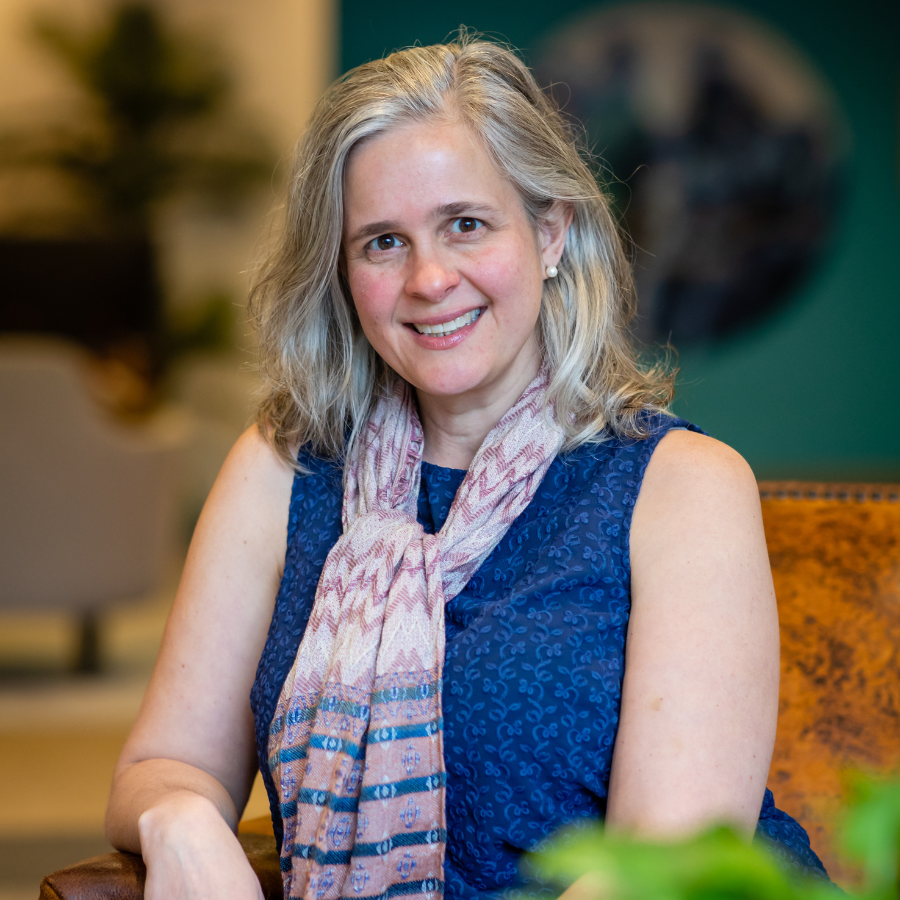
In her fifty years around the earth, Elisa Miller-Out, managing partner at Chloe Capital, has seen America and the world reinvent itself many times – both technologically and socially.
Elisa has always been passionate about moving women forward in the workforce. This passion aligns perfectly with her firm's identity as “a movement-driven venture capital firm with a mission to invest in an inclusive ecosystem building at scale.”
“We invest in founders who are overlooked by the traditional venture capital ecosystem, and we invest across energy, workforce, and health, mostly at the seed stage,” Elisa explains.
Her path to venture capital began as a software entrepreneur and “mentor and community builder” within the startup ecosystem. Repeatedly finding herself as one of the only women—and often the only mother—in the room at major tech conferences, she identified the industry's blind spot.
“I saw firsthand through that experience of over a decade in tech that there were obviously a lot of people who were being overlooked by the system,” she says. “Over and over again, I was seeing really talented entrepreneurs who maybe weren't getting the same access or the same capital or resources as others.”
She points to their funding in women’s health, from menstruation through maternity through menopause.
“When I think about all the incredible opportunities in that space – it's a massive market, we're half the population,” she says, adding that they are “just scratching the surface” of possibilities. “By going boldly into these spaces where other people are either unwilling or uninterested in going, we're uncovering these amazing opportunities that are overlooked.”
When it came to Chloe Capital, she says, it felt important to build a space in the tech world where all voices could be included in developing the ground-breaking technologies impacting all of humanity.
She says that as technology advances, from the introduction of mobile phones to the modern AI revolution, it is really important to bring all voices to the table. “We're deciding what these innovations are going to be for all of us and who is shaping those innovations.”
“The talent is there, the access is there. What the issue is is the actual capital flowing,” she asserts. “Whoever tells you that there's a pipeline problem, they just have not tried.”
This defining belief now guides her work at Chloe Capital, where she focuses on supporting women and other overlooked founders. Below, she shares her insights
supporting women and other overlooked groups.
Silver Lining?
Q: Given the current (and historical) hostility towards women entrepreneurs, do you see any positives emerging from today’s chaos?
I've lived for about half a century, and just in my lifetime, the ups and downs in attitudes towards women and diversity have literally been a roller coaster. It has not been linear, which never ceases to surprise me.
When I grew up, I was raised to believe women could do or be or accomplish anything. It felt like we were standing on the shoulders of women before us who really fought for those rights.
Then I had my own kids – I have two amazing daughters – and I see a world where rights I took for granted are being stripped away from them. It is very frustrating seeing that non-linear ebb and flow throughout my life.
But to your point about silver linings and positive outcomes, I think we're heading into a really interesting time. We have this multi-trillion-dollar wealth transfer happening to women in our lifetimes. I like to think we're approaching a significant shift in the world.
I like to think we are on the right side of history with the work we're doing. We're going through some bumps in the road, but we're riding toward some really exciting times as these shifts take place. It will hopefully be a really exciting time, but I don't think we're through the slings and arrows yet.
We've been doing this work – and I've been personally doing it – since before the #MeToo movement and before George Floyd and the Black Lives Matter movement. I will continue through this period, even as some movements swing in the opposite direction.
I'm proud that we're not doing this in a performative way or as part of a trend. It was never performative for us. We've actually been moving capital into these spaces and doing community work for a very long time. We hope to continue throughout our careers. This is a labor of love for me and our team at Chloe Capital.
We're passionate about this work because it's the right thing to do and it's the best way to achieve a thriving society for all of us.
This work is critical to ensure that as we develop big new technologies like AI – and I've seen many technological revolutions – these revolutions happen in a truly inclusive way. It could not feel more important, pressing, or critical in our lifetime. It feels like very, very important work, and I'm honored to be a part of it.
Bad Habits
Q: I'm curious about the types of founders that stand out to you. To follow that up, what standout traits do you see with male founders that you wish you saw more women embody?
With our founders, we look for "leaders who uplift others as they climb" mentality – no matter gender.
I really want to emphasize that it takes all of us to make this transformation happen. Those impacted by a certain issue are not the only ones that can make the change happen. It needs to be everyone, including the people who've put in place some of these structures.
Even in my lifetime, women couldn't get bank loans without a man co-signing for them … structural barriers. And those things really take all of us to create a better world. We really do believe that this is something that we can do as a group. It's a better world for everyone when women have equality.
There definitely are stereotypes and bias towards women in tech. For example, the promotion orientation versus prevention orientation, which was written about in that Harvard Business School study around how investors speak differently to men and women.
We really do see that play out within our industry. There will be men who say something that is forward-looking, whereas women might have to say something that's more defending their track record. We see that in the kinds of questions that people get asked.
But the beautiful thing about this – and what gives me a lot of hope and optimism – is that one of the results of that study in particular was that if you flip the script when you answer the question, you can actually get a better result.
If someone asks you as a woman a prevention-oriented question, such as about your past sales, you don't have to answer with specifics. You can still point to where your sales are going in the next five years.
This is part of why we do our accelerator programs and why we focus on entrepreneurial education. I really love working with folks to overcome some of these things through their work.
Lifting All Boats
Q: Based on your experience, what are some ways that women can use their own privilege to help lift all boats?
Luckily, we are seeing that happen already in so many beautiful ways. Across our portfolio, we observe that so many of these founders are naturally very community-oriented.
We find that while all founders are focused on building great businesses, women make incredible financial leaders. They are building very successful businesses from a monetary standpoint. They are also finding creative ways to build support for their community and social impact into their companies in meaningful ways.
We already know that women lead in areas like philanthropy and community development. So what's beautiful is that when women become successful entrepreneurs, they are building these principles into their business models right from the start.
Finding ways to build that into a business model—to give back to communities in ways that help, or at least don't hurt, the bottom line—is something we see happening all the time with the incredible, diverse women leaders we support in our portfolio.
That's something that inspires me every day. We get to work with leaders who have that focus.
About Beta Boom
Beta Boom is pre-seed and seed fund investing in founders who defy the mainstream.

BETA BOOM BACKS ORIGINALS
Investing at the pre-seed and seed stages in founders who defy the mainstream.

.png)
.png)
.png)