
Imagine asking an AI coding agent to clean up a staging environment and learning, minutes later, that it deleted production instead. Nobody approved that action. The agent simply held broad credentials, as most agents do today, and nothing stopped it. Incidents like this have made headlines, and they explain why so many enterprises are stuck. Workers want to use AI agents, but their security leaders have no reliable way to say yes.
That is the problem Endeem is built to solve. The company is coming out of stealth, and it has closed a $2.5M round that was oversubscribed. Beta Boom co-led the round alongside Auriga Cyber Ventures, a French fund focused on specialized cybersecurity investments.
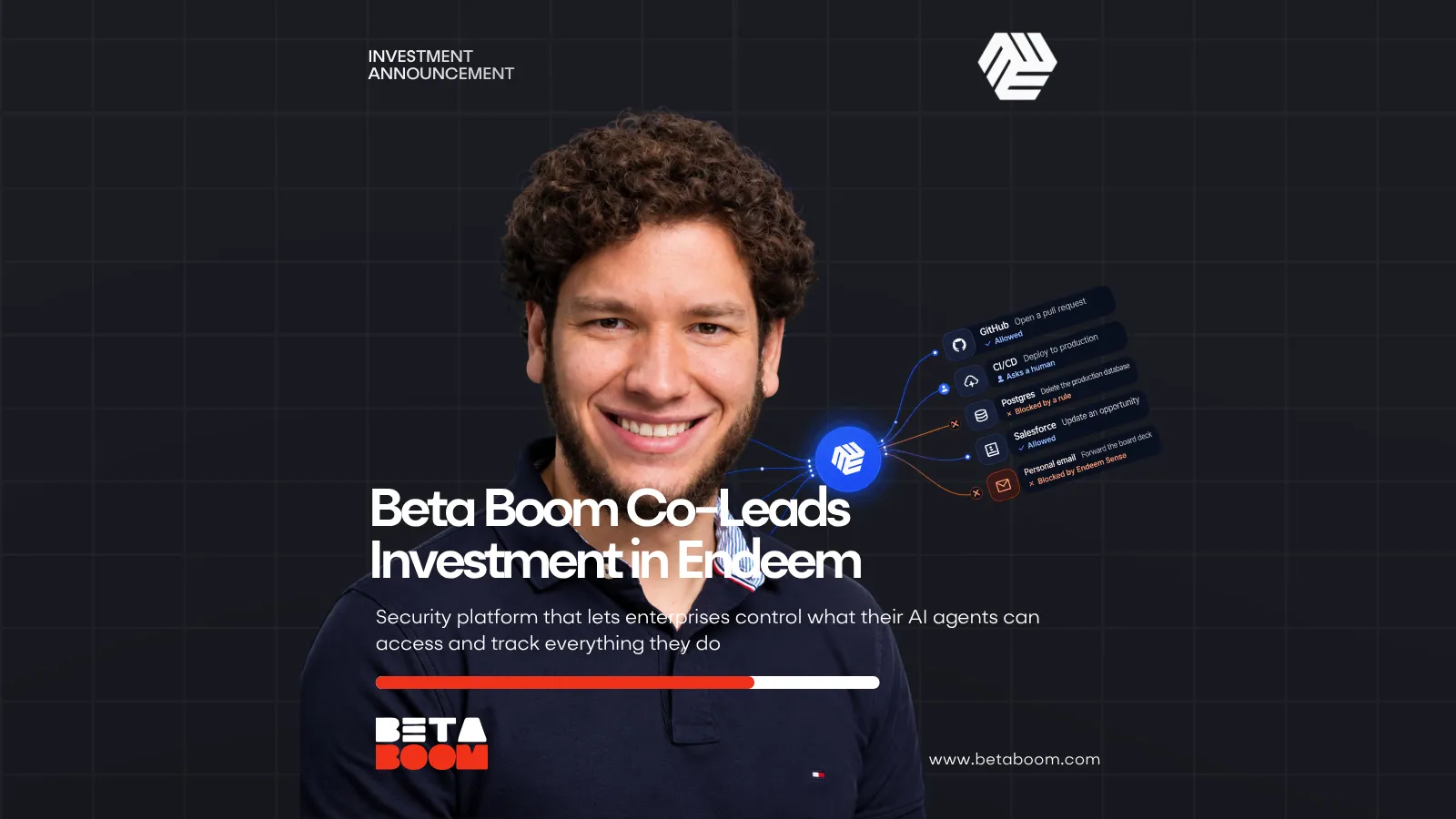
Endeem gives every AI agent its own identity and checks every request that agent makes against the rules a company sets. Enforcement happens on the machine where the agent runs, so it works with Claude Code, Codex, Claude Cowork, Microsoft Copilot, and in-house agents without changing the agent or how teams work. An agent reading logs gets through. One trying to deploy to production can be routed to a human for approval. One trying to delete a production database is blocked. The agent never holds standing credentials. Endeem issues short-lived credentials for each request, so a compromised agent exposes only the single action in flight. Every session is recorded, and if an agent steps outside the rules, Endeem can stop the session, block the agent, and revoke its access.
The current patchwork of tools leaves gaps. Identity providers can tell who a person is but cannot distinguish that person from the agent running on their laptop. MCP gateways only see traffic routed through them, and agents routinely run scripts, command-line tools, and direct API calls that bypass the gateway. Endeem sits where the agent actually runs, so those requests are still checked.
Yannick Pobiega, founder and CEO, has a path that does not look like the typical Silicon Valley profile, but his journey is truly exceptional. He got his first computer, an Amiga, at age eight. He taught himself C, C++, and x86 assembly through online tutorials and CrackMe challenges. By fourteen he was writing kernel-level game hacks for Counter-Strike and selling them. He left the traditional academic track early. He then joined Fresenius in Germany as a systems engineering apprentice, already determined to one day work at Big Tech in the United States.
Yannick made it happen. He spent more than four years as a technical consultant, selling services to enterprises in Germany, before becoming a Solutions Architect at AWS, where he worked with financial services customers to move legacy systems to the cloud. He then joined Microsoft as a Principal Engineer on the Azure RBAC and Managed Identity team, the systems that decide who and what is allowed to act across Azure. Most recently, at Defakto Security, he worked as architect and sales engineer, working directly with the product team and with customers. Endeem is the company that career has been preparing him to build: an authorization layer for the non-human actors now taking action inside enterprise systems.
Beta Boom backs original, pattern-breaking founders outside Silicon Valley, and Yannick fits that thesis perfectly. But the thesis alone was not the reason we invested. We invested for three reasons:
The need to govern and control agents is an enormous hair-on-fire problem. AI agents are moving from reading data to acting on it at machine speed, and enterprises need controls that ensure that agents do not cause catastrophic failures or mistakes. Deterministic policy, enforced across AI models, is the right answer, and Endeem is betting on it. Plus, visibility, auditability, and spend audit are key use cases that Endeem’s platform also addresses.
The timing for Endeem could not be better. Companies are being pushed to adopt agents on deadlines set from above, and the security teams asked to approve them lack tools built for the job. The buyers are ready now, and the first company to put a working control layer in place will shape how the category develops.
Finally, the founder is among the most effective we’ve seen. We watched Yannick over a few months, and his execution was world-class. Over the time we tracked Yannick and his team, he overdelivered on all of his plans. Plus, Yannick understands this problem thoroughly from his work at Microsoft and Defakto Security, and he moves quickly on what he learns from customers. We wanted to back someone who had already built the hard parts of identity and access control before deciding to start a company around them. That combination of experience and world-class execution is what convinced us.
Endeem is piloting its platform with multiple enterprises in pharmaceuticals, financial services and IT software, including a top 20 global pharmaceutical company.
The round gives Endeem room to turn early conversations into paying customers and to finish the work enterprise buyers ask for, including simpler policy configuration, a clearer console, and the controls security and procurement teams expect.
Reach out
If you are building in AI agent security, identity, or the controls that make autonomous software safe to deploy, apply to Beta Boom at betaboom.com/apply.
If you are an investor interested in co-investing in Endeem or following its progress, reach out to Sergio Paluch or Kimmy Paluch at Beta Boom.
To connect with the founder, reach out to Yannick Pobiega on LinkedIn, or contact Beta Boom and we will make the introduction.
About Beta Boom
Beta Boom is a pre-seed and seed-stage venture capital firm backing startups that are solving complex workflows in Enterprise, Cybersecurity, and Healthcare. Plus, Beta Boom loves tenacious pattern-breaking founders based outside of Silicon Valley.
About Beta Boom
Beta Boom is a pre-seed and seed fund investing in startups solving complex workflows in enterprise, cybersecurity, and health and led by pattern-breaking founders outside of Silicon Valley.

BETA BOOM BACKS PATTERN BREAKERS
Investing at the pre-seed and seed stages in founders who defy the mainstream.